
Generally the levels of dust are not a problem in the indoor environment unless a close source is present in close vicinity. In this case I have been invited to investigate the indoor air quality in an office building located in an industrial part of the city. The indoor air quality in the building was not bad as such, but the employees have been complaining from unusual dustiness in their offices. The dust accumulated on office window sills was black and coarse in nature. I have collected numerous samples of the dust for microscopic and chemical analysis.

Two weeks accumulation of dust on a window sill
The chemical analysis of the dust shows presence of heavy metal components such as zinc, copper, chromium, iron and lead. All of these metals can be found in steel and metal products. Microscopic analysis further confirmed the presence of mainly iron oxide particle showing as light brow/red under microscope.
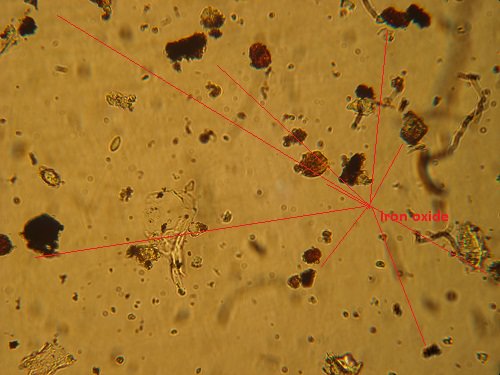
Gray, coarse dust from the office windows sills shows high concentration of iron oxide particles
Microscopic and chemical analysis of the accumulated dust helped to identify the source of the dust contamination as the nearby scrap metal y processing yard. The site handles large quantities of metal components which are stored and plasma cut outdoors. The cutting and handling process can generate significant quantities of metal fumes and dust which is carried indoor.
In comparison to the window sill samples I have also collected samples from floors. These samples also show metal particles along with other typical dust components such as fibres, mould spores and mineral particles.
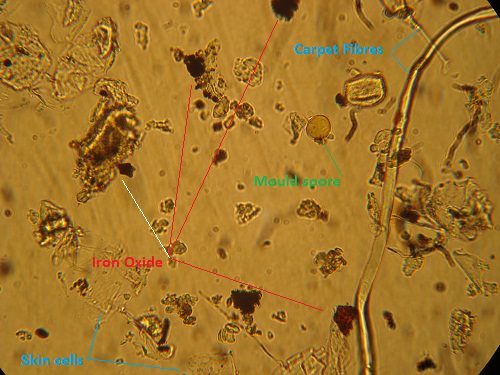
Dust from office floor carpet
Typically dust commonly found indoors in homes and offices consists primarily of human skin cells, hence the off grey colour of the dust. Dust taken from the shelves inside of the office building shows an abundance of skin cells with small amounts of iron oxide.

Typical household or offce dust
