
Investigation of indoor air quality is a complex process involving often involving analysis of numerous components of air and often with no clear cut results. The problem with indoor air quality assessment is the fact that you can only realistically measure only small number of possible contaminants. The main hindering factor in any investigation is the analytical cost involved and the fact that often the inspector doesn’t really know what he/she is walking into. The dilemma lies in the fact that the customers often what a full indoor air quality investigation involving sampling and complete analysis of the indoor air but are not prepared to finance such extensive testing.
Any investigator then has to resolve the dilemma on site and chose the most likely method and target contaminant he/she wasn’t to sample. Problems usually arise when whatever the analyst has sampled turn out no to be a problem. I have recently completed indoor air quality investigation in one London apartment. The apartment, or more specifically a small part of it, suffered from air quality problems which manifested itself by noticeable odour in the affected room and respiratory irritation of the young occupant living in the room.
I have visited the property and performed a series of tests ranging from particle counts, microscopic air contaminants analysis, mould spore sampling to visual inspection and cavity wall sampling and inspection. While I was on site I have decided that to resolve this indoor air quality problem I would have to sample for chemical contaminants in the air as well.
None of the analysis offered a clear cut identification of the problem but each one showed a possible partial contributor to the overall indoor air quality issue.
Sampling for indoor moulds and cavity wall contamination showed the presence of abundant conidial chains and fragment of hyphae, suggesting that mould contamination inside the wall cavity is likely. Mould spore observed could not be identified just by microscopic examination and full culturing and identification was not performed.
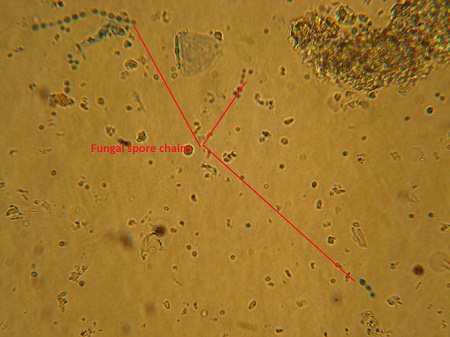
Mould spore chains in wall cavity
Microscopic analysis of contamination of the indoor air showed the presence of large number of fine fibrous material, along with plentiful of skin cells and other particulate debris. This kind of analysis can offer only limited information about the nature of the contaminants but some common and typical contaminates such as pollen, fungal spores and fragments, skin cells, fibres, large opaque particles and insect parts can be relatively easily recognised.
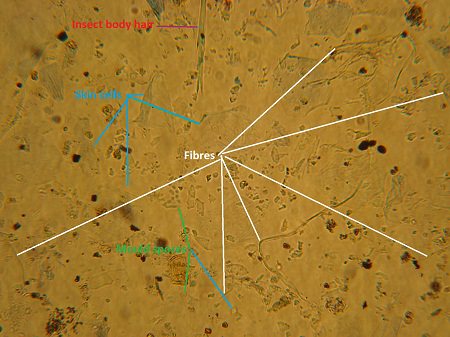
Particulate composition of indoor air
Chemical analysis of the indoor air showed the presence of acetaldehyde, toluene, formaldehyde, naphthalene, undecan, nonanal, acetic acid and others. All these contaminants can be found in paints, solvents, adhesives or manufactured building products. In this particular case the concentration of naphthalene was rather high and certainly at concentration exceeding the odour threshold level.
At the end of my investigation I have concluded that the naphthalene is most likely cause of the unpleasant odour, elevated particle and spore count is the most likely cause of respiratory irritation. Another very important contributing factor was the very low humidity in the house which was in the region of 30%, considered as low and likely to cause drying of mucous membranes. I have also concluded that the most likely source of the contaminants is the room’s carpet and possible mould contamination of the wall cavity.
By Tomas Gabor
